
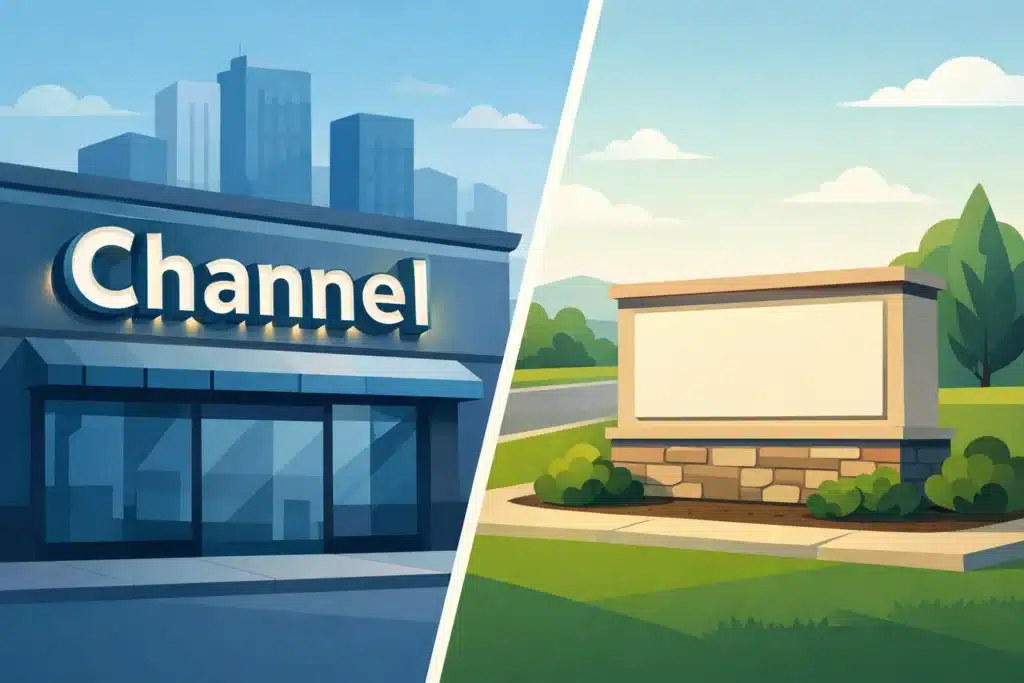
A customer approaching your property may have only a few seconds to find the entrance, recognize your brand, and decide they have reached the right place. That is why the channel letters vs monument sign decision is more than a design preference. It affects visibility from the road, the way your building presents itself, and how easily visitors can navigate your site.
Both sign types are proven exterior branding tools, but they solve different problems. Channel letters put your identity directly on the building. Monument signs establish a clear presence at the edge of the property. The right choice depends on your building, setback, traffic patterns, local regulations, and the role the sign needs to play.
Channel Letters vs Monument Signs: The Core Difference
Channel letters are individually fabricated letters, numbers, or logo elements mounted to a building facade, raceway, or other architectural surface. They are commonly illuminated, using internal LED lighting or halo lighting behind the letters. Because they are dimensional and customizable, channel letters create a polished, permanent presence for storefronts, office buildings, medical facilities, restaurants, and multi-tenant commercial properties.
A monument sign is a freestanding ground sign, usually built at a lower height than a pylon sign. It is typically installed near a driveway, property entrance, or street frontage. Monument signs may use masonry, stone, metal panels, routed lettering, digital displays, or internally illuminated cabinet faces. They are often designed to complement the architecture and landscaping of the site.
Put simply, channel letters identify the building itself. Monument signs identify the property and help people find it from the road.
When Channel Letters Are the Better Fit
Channel letters are often the strongest choice when the building facade is visible from the street and your goal is immediate brand recognition. They work especially well for businesses in retail centers, professional offices, healthcare campuses, hospitality properties, and restaurants where customers need to confirm they have arrived at the correct entrance.
Strong building-level visibility
If drivers and pedestrians can clearly see your storefront or facade, mounted channel letters make efficient use of that exposure. The sign becomes part of the building rather than another object competing for attention near the road. Larger letters, appropriate contrast, and illumination can help the name remain legible across a parking lot or from a nearby arterial street.
This approach is particularly effective when a business is located in a shared commercial center. A monument sign may list every tenant, while channel letters give your specific suite or storefront the visibility needed to stand apart once visitors enter the site.
A more dimensional brand presentation
Flat vinyl or panel lettering can communicate a name, but fabricated channel letters add depth, shadow, and nighttime presence. Front-lit letters are a common option for high visibility after dark. Halo-lit letters create a more refined appearance, with light washing softly onto the wall behind each letter. Non-illuminated dimensional letters can also be the right fit for properties with good ambient lighting or more restrained architectural requirements.
The best lighting style depends on your brand, operating hours, and municipal sign code. A restaurant open late has different visibility needs than a professional office that closes at 5 p.m.
Consider the facade before committing
Channel letters need a suitable mounting surface. The facade must provide enough clear area, proper structural support, and a location that does not conflict with windows, canopies, rooflines, or building features. Electrical access also matters for illuminated letters.
Landlord criteria and shopping-center sign standards can be a deciding factor. Many centers specify letter height, color, illumination type, and installation methods. A sign team should review these requirements early, before design work gets too far ahead of approvals.
When a Monument Sign Makes More Sense
A monument sign earns its place when your building sits back from the road, shares a drive with other businesses, or needs to be identified before visitors reach the parking lot. It is often the first sign a driver sees, which makes it essential for wayfinding as well as branding.
Better roadside and entrance identification
For a business set behind parking, landscaping, or another building, facade signage alone may not be enough. Customers can see your name only after they have already turned into the wrong entrance or passed the property. A monument sign creates an earlier decision point, helping visitors locate the driveway and understand where to go.
This is useful for medical offices, schools, industrial facilities, apartment communities, churches, corporate campuses, and businesses on larger parcels. It also helps properties located along busy roads where drivers have limited time to read signs.
Built for the property, not just the logo
Monument signs can carry more information than channel letters. In addition to a primary business name and logo, they can incorporate suite listings, directional messaging, address information, tenant panels, and changeable copy. For multi-tenant sites, that flexibility is often the deciding advantage.
The sign structure can also reinforce the property’s architecture. A stone base may suit a healthcare or residential campus, while a clean metal-and-aluminum structure may better match a modern office or industrial property. Materials should be selected for Colorado and Wyoming weather conditions, including sun exposure, snow, wind, and temperature swings.
Expect more site coordination
Unlike building-mounted letters, a monument sign involves site work. Placement, footing design, underground electrical, utility locates, irrigation, landscaping, and access for installation all need to be coordinated. Permitting may also require a site plan, sign elevations, engineering details, and landlord or property-owner approval.
That added scope does not make monument signs a poor choice. It simply means the project should begin with a realistic timeline and a clear review of site conditions.
Compare Visibility Before Comparing Cost
Price matters, but the lowest initial sign cost is not always the best business decision. A sign that customers cannot see or understand at the right moment is not doing its job. Before choosing between channel letters and a monument sign, consider where your audience is coming from and what they need to know.
If most customers arrive on foot from a nearby parking area, building-mounted channel letters may deliver the greatest value. If they are approaching at 35 to 50 miles per hour from an unfamiliar road, a monument sign may be more useful. Businesses with a long driveway or multiple entrances may need a monument sign at the street plus additional directional signs farther into the site.
Letter size is also critical. A brand name that looks substantial on a proof can become difficult to read when installed far from the viewer. Viewing distance, vehicle speed, sign height, background contrast, and illumination all affect real-world readability. A professional sign layout accounts for these conditions before fabrication begins.
Permitting and Property Rules Can Decide the Issue
Local sign regulations often limit the size, height, number, location, and lighting of exterior signs. A municipality may allow wall signage but restrict freestanding signs, or it may set a specific maximum area for a monument sign based on street frontage. Planned developments and shopping centers can add another layer of requirements.
For channel letters, the key questions are usually permitted sign area, facade location, illumination, and building-owner standards. For monument signs, regulations may address height, setback from the right-of-way, distance from driveways, electronic message centers, and landscaping requirements.
This is where early planning prevents expensive rework. A sign concept should be checked against applicable codes and property criteria before materials are ordered or installation dates are promised.
Many Properties Need Both Sign Types
The choice is not always channel letters or a monument sign. Many successful commercial sites use both because each sign handles a different part of the customer journey. The monument sign gets attention at the road and directs visitors onto the property. Channel letters confirm the destination at the building and strengthen the brand experience at the entrance.
A multi-tenant retail center may use a shared monument sign for tenant listings, individual channel letters for each storefront, and directional panels for pickup areas or rear entrances. A healthcare campus may use a monument sign for campus identification, building letters for each department, and interior wayfinding to carry visitors the rest of the way.
The key is consistency. Colors, typefaces, logo proportions, materials, and illumination should feel coordinated across the entire sign program, even when each sign serves a different function.
Plan the Sign Around the Actual Site
The strongest exterior signage starts with a site review, not a catalog selection. Look at sightlines from the road, traffic direction, parking layout, building architecture, existing utilities, code restrictions, and the places visitors are most likely to hesitate. Those details determine whether a single sign type will solve the problem or whether a coordinated system is needed.
Action Signs can manage that process from design and fabrication through permitting coordination, installation, and ongoing service. The goal is not simply to install a sign that looks good on opening day. It is to put your name where customers can see it, recognize it, and act on it for years to come.


