
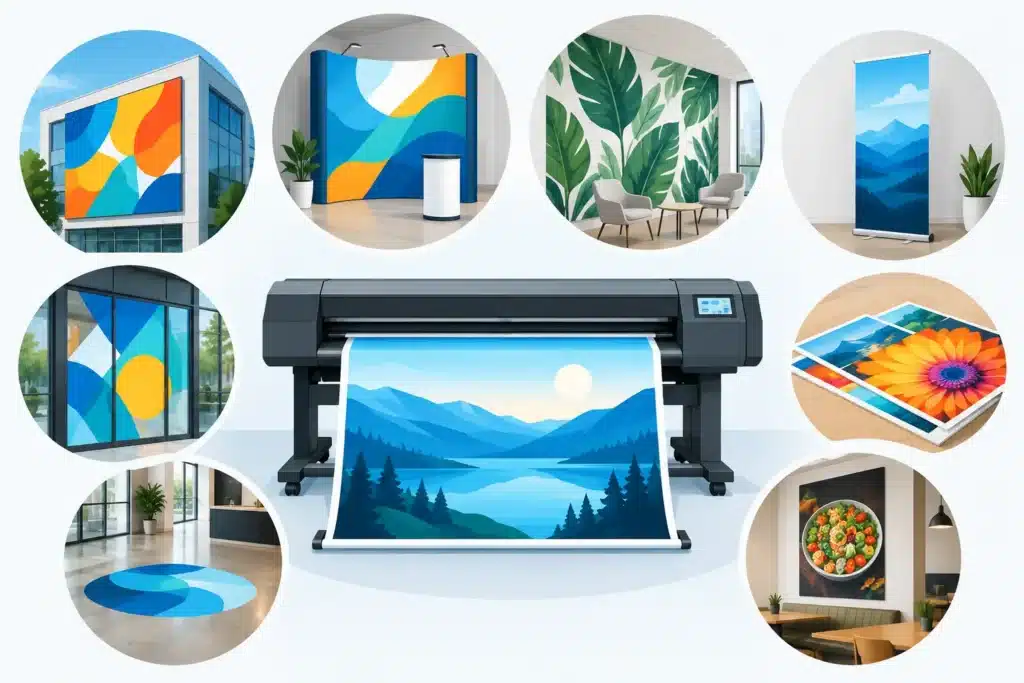
A new location can have the right address, great service, and a polished interior, yet still lose customers because people cannot tell what it is from the street. That is where large format printing uses become a practical business tool, not simply a decorative choice. Printed graphics can make a brand visible, direct visitors, promote an offer, or turn underused surfaces into working marketing assets.
The best application depends on viewing distance, installation conditions, expected lifespan, brand standards, and local requirements. A window graphic meant to last through a seasonal promotion needs a different material and installation approach than a permanent wall mural or a fleet wrap that will face Colorado sun, snow, road grit, and frequent washing.
Where Large Format Printing Earns Its Keep
1. Storefront windows and entry graphics
Storefront windows are often the first large surface a customer sees. Perforated window film, vinyl lettering, full-color graphics, and temporary promotional panels can communicate your name, hours, services, specials, or a grand opening message before someone reaches the door.
The right level of coverage matters. Full window graphics create impact and can provide privacy, but too much coverage can make a retail space feel closed off. For professional offices, restaurants, healthcare facilities, and service businesses, a balanced design often preserves daylight and outward visibility while clearly identifying the business.
2. Exterior building banners and wall graphics
Banners and printed wall graphics help businesses claim visibility when a monument sign, channel letters, or another permanent sign is not enough on its own. They work well for seasonal campaigns, lease-up activity, new services, special events, and temporary branding during construction or renovation.
Material selection should match the location. A banner stretched across an exterior wall has different wind exposure than one mounted inside a lobby. Hemming, reinforcement, mounting hardware, and the condition of the mounting surface all affect how the finished piece performs. For exterior installations, planning for weather is part of the job, not an afterthought.
3. Vehicle wraps and fleet graphics
A company vehicle spends its workday in parking lots, neighborhoods, job sites, and on major roads. That makes vehicle graphics one of the most visible large format printing uses for contractors, delivery teams, property managers, healthcare providers, and regional service businesses.
A full wrap creates a high-impact branded vehicle, while partial wraps and spot graphics can be a more cost-conscious fit for a growing fleet. The decision is not only about budget. Vehicle contours, paint condition, body panels, required identification, and how long the vehicle will remain in service should guide the scope. A clear logo, phone number, service category, and readable design usually outperform a crowded layout.
4. Construction site and development signage
Construction sites need signs that do real operational work. Printed site signage can identify the project, recognize partners, display safety messaging, direct deliveries, post leasing information, and create a more professional perimeter around an active job site.
For developers and contractors, consistency matters across changing conditions. A project may need early-stage land signage, permit boards, construction fence banners, directional signs, and leasing graphics at different points in the schedule. Working from a coordinated graphic system keeps the site organized while helping the public, subcontractors, and inspectors find the information they need.
5. Interior wall murals and branded environments
Blank interior walls can become a clear part of the customer experience. Large printed wall graphics are used in lobbies, conference rooms, waiting areas, hallways, training spaces, retail interiors, and employee break rooms to carry brand color, history, imagery, or a focused message.
This is not limited to decorative murals. A healthcare office may use calming graphics to make patient areas feel less clinical. A manufacturer may display capabilities and safety culture in its lobby. A school or campus facility may turn a long corridor into an easy-to-follow visual landmark. Surface preparation and paint condition are especially important because wall texture, moisture, and fresh paint can affect adhesion.
6. Wayfinding and temporary directional graphics
People notice poor wayfinding when they are already frustrated. Large printed directional graphics can help visitors locate entrances, departments, event check-in areas, parking zones, pickup points, and accessible routes without adding permanent fixtures where they are not needed.
They are particularly useful for hospitals, campuses, large offices, warehouses, retail centers, and events with shifting traffic patterns. Floor graphics, window decals, temporary wall panels, and mounted printed signs can work together, but placement should be tested from the visitor’s point of view. A sign that is technically visible may still be missed if it appears too late in the decision path.
7. Trade show displays and event graphics
At an event, businesses have only a few seconds to communicate who they are and why a visitor should stop. Backdrops, retractable banners, table throws, display panels, and oversized product imagery give a booth or event space a more complete presence.
Portability is often the key trade-off. A rigid display may look substantial, but it can be harder to transport and store. A fabric or retractable system is easier to reuse, though it may not be the best choice for every environment. The most effective event graphics are built around one main message and a readable visual hierarchy rather than trying to explain every service at once.
8. Retail promotions and point-of-purchase displays
Large-format graphics help retailers create urgency and guide shoppers through a space. Window promotions, aisle-end graphics, oversized sale panels, cooler wraps, counter displays, and temporary wall decals can support product launches, holiday campaigns, and clearance events.
Because these applications may change frequently, speed and ease of replacement are part of the planning process. A durable permanent panel is not always the right answer for a promotion that will run for six weeks. A well-designed temporary graphic can look polished while allowing the store to refresh messaging as inventory and campaigns change.
9. Privacy and decorative films
Printed and frosted films solve a practical problem in offices, clinics, schools, and service counters: people need visual separation without making a space feel enclosed. They can add privacy to conference rooms and treatment areas, obscure back-of-house views, or reinforce a brand with subtle patterns and logos.
Coverage level should be chosen carefully. Frosted film offers a clean architectural look and can preserve light, while printed graphics create more branding opportunities. In either case, alignment around door hardware, glass seams, sightlines, and safety markings separates a professional installation from a quick application.
10. Fleet, equipment, and trailer identification
Beyond standard vehicle wraps, wide-format printing supports equipment decals, trailer graphics, safety labels, and identification systems for organizations with mobile operations. Construction companies, municipalities, agricultural businesses, and industrial firms can standardize branding across trucks, enclosed trailers, tool units, and specialty equipment.
These surfaces tend to experience harder use than a passenger vehicle. Abrasion resistance, cleaning methods, panel seams, and visibility requirements all deserve attention. For safety-related messages, readability takes priority over visual complexity.
11. Real estate, leasing, and property marketing
Developers, property managers, and commercial brokers use printed graphics to market available space long before a permanent tenant sign is installed. Window graphics, site banners, building wraps, leasing panels, and directional signs can make a property easier to identify and help prospects act on the information they see.
The strongest property graphics account for the vehicle speed and distance of the audience. A message aimed at passing traffic needs far fewer words than a leasing panel viewed on foot. Phone numbers, web addresses, and tenant details should never compete with the central availability message.
12. Short-term campaigns and community communication
Not every sign needs to last for years. Large-format printing gives businesses, institutions, and local organizations a practical way to communicate a temporary change: a new entrance, a holiday schedule, a community event, a sponsorship, a renovation, or a safety update.
The short lifespan is an advantage when the material is selected intentionally. Temporary graphics can be produced for efficient removal, helping facilities avoid the cost and visual clutter of leaving outdated signs in place. For public-facing messages, confirm whether the application requires property approval, landlord coordination, or local permitting before production begins.
Choosing the Right Print Method, Material, and Installation
A good graphic starts with a business goal, but its success is determined by execution. The same artwork can look excellent on a storefront window and fail quickly on a textured exterior wall if the wrong film, laminate, or mounting method is used.
Start by defining how far away the audience will be, how long the graphic should remain in place, and what conditions it will face. Then consider the surface itself. Glass, painted drywall, brick, aluminum composite panels, corrugated metal, concrete, and vehicle paint each call for different products and preparation. Installation access also affects the project. A second-story banner, a wall wrap around architectural features, or a fleet project with multiple vehicles requires scheduling and site coordination that should be addressed before production.
Design should follow the same practical discipline. High-resolution images, readable type, correct logo files, and appropriate color expectations help avoid expensive changes. A print partner that handles design, production, and installation in-house can identify issues earlier, maintain color consistency across applications, and coordinate the details that keep a project moving.
A printed graphic has value when it helps someone find your business, understand your message, or take the next step. For Northern Colorado and Southern Wyoming companies, Action Signs can help turn that need into a finished solution that fits the site, the schedule, and the way your business operates.


