
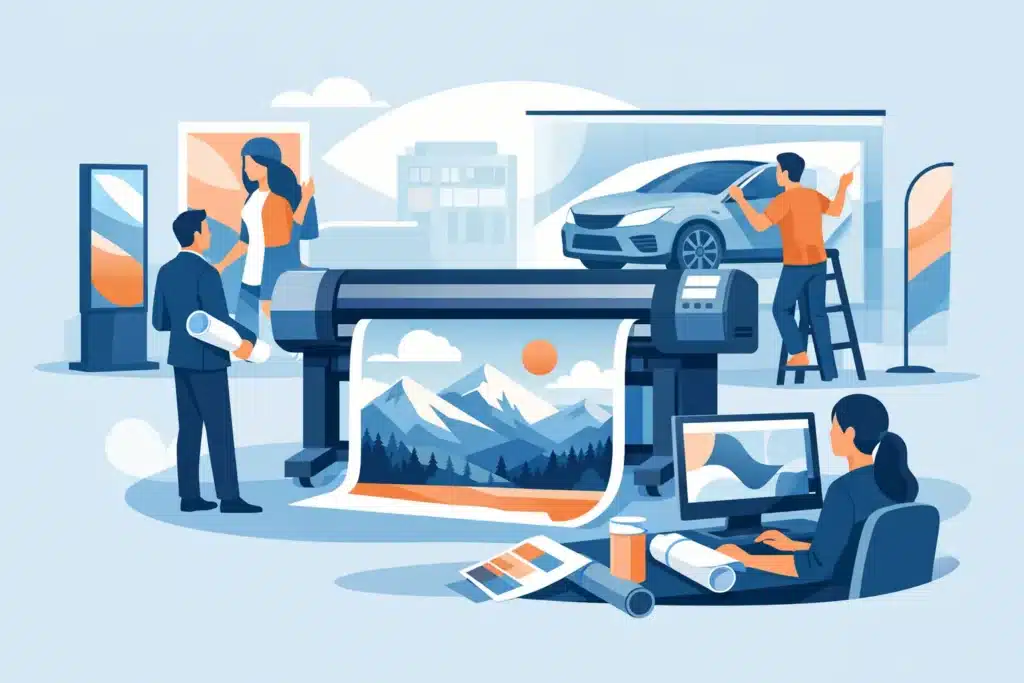
A blank storefront window, an unmarked service van, or a confusing lobby can all cost a business attention before a customer ever speaks with an employee. Large format printing turns those high-visibility surfaces into practical business tools. So, what is large format printing used for? It is used to create oversized, full-color graphics that help companies attract customers, direct visitors, promote offers, communicate on jobsites, and keep their brand visible across physical locations.
For businesses in Northern Colorado and Southern Wyoming, the value is not simply printing something bigger. It is choosing the right material, finish, mounting method, and installation approach for where the graphic will live and what it needs to accomplish.
What Is Large Format Printing Used For?
Large format printing is commonly used for graphics too large for standard office printers, including banners, window graphics, wall murals, vehicle wraps, trade show displays, construction signs, point-of-purchase displays, and directional signage. These pieces are produced on materials such as vinyl, fabric, rigid plastic, aluminum composite, foam board, and specialty films.
The best application depends on viewing distance and environment. A banner seen from across a parking lot needs bold type and high contrast. A wall graphic in a reception area can carry more detail because people will view it up close. Exterior graphics also need materials and inks that can stand up to sun, wind, moisture, temperature swings, and regular cleaning.
Storefront Windows and Exterior Promotions
Storefront graphics are among the most visible uses of large format printing. Retailers, restaurants, medical offices, gyms, and service businesses use window vinyl to announce opening dates, seasonal promotions, new services, hours, or temporary closures. Perforated window film can display a full-color message on the outside while preserving outward visibility from inside.
For a new business, window graphics can make an unfinished space look active before permanent signage is installed. For established businesses, they offer a cost-effective way to refresh promotions without rebuilding a sign cabinet or changing the building facade. The trade-off is permanence: promotional graphics are designed to change, while dimensional letters and illuminated signs are better suited to a long-term identity.
Vehicle Wraps and Fleet Graphics
Company vehicles spend the workday in neighborhoods, on highways, at customer locations, and at jobsites. Large format printing makes it possible to turn those vehicles into consistent mobile advertising through full wraps, partial wraps, door decals, and fleet identification graphics.
A full wrap creates the strongest visual impact, but it is not always necessary. A well-designed partial wrap or set of branded graphics can deliver clear identification at a lower cost, especially for a growing fleet. The priority should be legibility. A passing driver has only a few seconds to understand who the company is and how to contact it.
Fleet graphics also serve an operational purpose. Branded vehicles help customers identify arriving technicians, improve jobsite professionalism, and create consistency across teams working in different service areas.
Banners, Event Displays, and Temporary Messaging
Banners remain a dependable choice when a message needs to be seen quickly and removed or updated later. Businesses use them for grand openings, community events, sales, sponsorships, recruiting, property leasing, and temporary directional needs. They can be finished with hems, grommets, pole pockets, or hardware suited to the installation location.
Not every banner belongs outdoors. Retractable banner stands, fabric displays, tabletop graphics, and backdrops are common for conferences, hiring events, trade shows, presentations, and lobby promotions. Indoor displays typically prioritize print detail and appearance, while outdoor banners require stronger finishing and more attention to wind exposure.
A banner should never be treated as an afterthought. Placement, mounting, and message hierarchy matter. A banner with too much copy may be technically accurate but ineffective from the road or across a crowded event space.
Printed Graphics for Interiors and Wayfinding
Large format printing is also used to make indoor spaces easier to navigate and more aligned with the company brand. This is particularly useful for healthcare facilities, schools, office buildings, hospitality spaces, manufacturing sites, and multi-tenant properties where visitors need clear direction.
Wall murals can reinforce a company story, create a more welcoming reception area, define meeting spaces, or add visual interest to long hallways. Frosted vinyl on glass can provide privacy for offices and conference rooms while carrying subtle branding or decorative patterns. Floor graphics can guide traffic, support safety messaging, or identify pickup and service areas.
Wayfinding graphics are most effective when they work as part of a larger sign system. A printed directional panel may be appropriate for a temporary route or changing department layout. For permanent building navigation, it may need to coordinate with architectural signs, room identification, ADA requirements, and exterior directional signage. A single production partner can help prevent those pieces from feeling disconnected.
Construction Sites and Property Development
Contractors, developers, architects, and property managers use large format printing to communicate clearly at active sites. Common applications include construction fence banners, project identification signs, safety notices, leasing graphics, site maps, and temporary directional signs.
These graphics have a job to do beyond branding. They can help control site access, identify project partners, guide deliveries, and provide information to prospective tenants or buyers. Because construction conditions are demanding, material selection matters. A temporary panel exposed to wind, dust, and weather needs a different solution than a polished leasing display placed inside a sales center.
For multi-phase projects, planning ahead can also reduce waste. A sign system that allows printed panels to be swapped as project details change is often more practical than replacing the entire structure each time.
Retail, Product, and Point-of-Purchase Displays
Inside retail stores, dealerships, showrooms, and service counters, printed graphics help customers notice what matters most. Window decals, aisle markers, product displays, counter graphics, and promotional boards can direct attention to a launch, sale, seasonal offer, or featured service.
This use of large format printing works best when the message is focused. One strong offer with a visible call to action usually performs better than a crowded graphic trying to communicate every product category. Businesses with multiple locations should also pay close attention to color consistency and approved brand assets so promotions look like they belong to the same company.
Choosing the Right Large Format Print Solution
The question is not only what can be printed. It is what the graphic must withstand, how long it will be used, and how people will encounter it. Before production begins, consider the viewing distance, installation surface, lighting, expected lifespan, and whether the message will change often.
Outdoor vinyl and rigid panels are often practical for durable exterior applications, while fabric and specialty wall films can be better choices for refined interior environments. Laminates may add protection from UV exposure, abrasion, and cleaning. Installation also affects performance. A graphic can be printed correctly and still fail early if the surface is not prepared, hardware is undersized, or the installation does not account for weather and site conditions.
Design deserves the same attention. Logos, colors, and type should remain recognizable at the intended scale. High-resolution artwork is helpful, but a large file alone does not guarantee a readable sign. Experienced designers build layouts around distance, placement, and the purpose of the message.
When Large Format Printing Works Best
Large format printing is especially useful when a business needs speed, flexibility, and visual impact. It can support a permanent sign program, fill a temporary need, or bridge the gap during a remodel, expansion, or rebrand. It is not always the right answer for every application. Long-term exterior identity may call for channel letters, monument signage, or routed dimensional elements rather than a printed graphic alone.
The strongest results come from treating print as part of the broader customer experience, not as a standalone item. A storefront graphic should support the exterior sign. Vehicle graphics should match the company website, uniforms, and sales materials. Interior wayfinding should help visitors move with confidence.
Action Signs helps businesses bring those moving parts together, from design and in-house production to installation and ongoing service. When the material, message, and placement are planned around a real business goal, large format printing does more than fill space – it helps people find you, understand you, and take the next step.


