
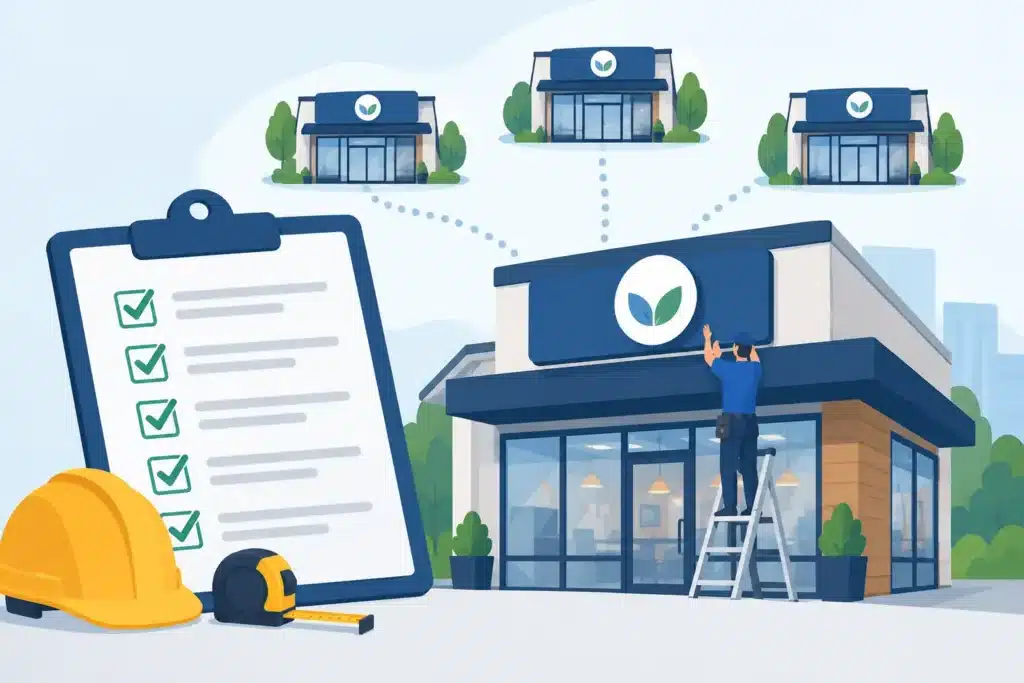
A franchise opening can look ready from the parking lot while still being weeks away from a usable sign package. The storefront may be built, fixtures may be in place, and staff may be preparing to train, but an unapproved monument sign, a delayed electrical connection, or missing interior wayfinding can hold back the launch. A franchise signage rollout checklist brings those moving parts into one working plan before deadlines become expensive problems.
For franchise operators, developers, facilities teams, and general contractors, signage is not a final decorative step. It is a coordinated construction, branding, and compliance scope. The right process protects brand standards while accounting for the realities of each site, including landlord rules, municipal codes, existing conditions, weather, access, and installation timing.
Start With the Brand Package and Site Scope
Every rollout should begin by separating what is fixed by the franchise brand from what must be adapted for the location. Obtain the current brand standards, logo files, color specifications, approved sign types, typography, illumination requirements, and any required vendor or approval procedures. Do not rely on an old sign from another location as the source of truth. Brand standards change, and a sign that was approved in one municipality may not meet the requirements in another.
Then build a location-specific scope. A typical site may need primary building signage, wall or cabinet signs, channel letters, window graphics, parking and directional signs, menu boards, interior lobby branding, ADA room identification, wall graphics, drive-thru signage, and exterior monument or pylon panels. The exact package depends on the business model, site layout, and franchise requirements.
Before design begins, confirm who has authority to approve each element. Corporate brand teams, franchisees, landlords, developers, property managers, and local jurisdictions may all have a role. Establishing that approval path early prevents a common delay: finished artwork waiting for a decision-maker who was not included at the start.
Franchise Signage Rollout Checklist: Verify the Site
A site survey is where brand intent meets physical reality. Measurements from plans are helpful, but they do not replace field verification. A qualified survey should document the building facade, sign bands, structural conditions, electrical availability, mounting surfaces, access routes, parking conditions, and existing signs that must be removed or modified.
Use the site review to confirm these details:
- Exact dimensions of signable areas, including wall space, raceways, parapets, and sign bands
- Building materials and mounting conditions, such as brick, EIFS, metal panels, concrete, or glass
- Electrical location, circuit capacity, disconnect requirements, and access to power
- Visibility from primary traffic approaches, drive lanes, sidewalks, and neighboring businesses
- Equipment access for lifts, cranes, ladders, or installation vehicles
- Existing landlord signs, tenant panels, monument cabinets, and removal requirements
This is also the point to identify trade-offs. Channel letters may be the preferred brand standard, for example, but the building structure, landlord criteria, or budget may require a cabinet sign or a different mounting method. A good signage partner can preserve the visual intent while recommending a practical, code-compliant solution.
Check Visibility Before Approving Final Sizes
Sign size is not just a design decision. It affects how quickly customers can identify the location from the road and whether the sign can be read at the actual viewing distance. A storefront in a dense retail center has different visibility needs than a freestanding location along a high-speed corridor.
Review sightlines from both directions of travel. Trees, neighboring tenant signs, parking lot lighting, awnings, and building setbacks can all reduce visibility. If a monument sign panel is available, verify the franchise name is large enough to be useful rather than simply present.
Coordinate Landlord Approval, Permits, and Construction
Sign permits are often on the critical path, particularly for illuminated exterior signs, monument signs, and new electrical work. Permit requirements vary by city, county, and property type. Some jurisdictions require engineered drawings, electrical permits, landlord authorization, or planning review before fabrication can begin.
Landlord approval should not be treated as a formality. Most commercial properties have sign criteria governing location, size, colors, illumination, mounting, and tenant panel layouts. Submit complete drawings that show the proposed sign in context with the building elevation or monument structure. Incomplete submittals invite revisions and lost time.
Coordinate closely with the general contractor when a project is under construction. Signage may require blocking behind walls, dedicated electrical circuits, conduit runs, concrete footings, or structural support before finishes are complete. Waiting until the sign is ready to discover that power was never brought to the location is one of the most avoidable rollout failures.
Allow time for review cycles. A straightforward wall sign may move quickly, while a new pylon sign or variance request can take substantially longer. It depends on the municipality, the property, and whether the proposed sign fits existing code. Build permit lead time into the opening schedule rather than assuming fabrication can begin immediately after artwork approval.
Approve Production-Ready Artwork
A sign design can look correct in a digital proof and still be difficult to fabricate, install, or read in the field. Production-ready approval confirms more than logo placement. It should address dimensions, materials, colors, illumination, mounting details, copy, ADA requirements, and the relationship between each sign and its installation surface.
For exterior signs, specify whether illumination is required and how it will appear at night. Front-lit channel letters, halo-lit letters, cabinet signs, and non-illuminated dimensional letters each create a different visual result and come with different installation and maintenance considerations. The best choice depends on franchise standards, site conditions, operating hours, and local restrictions.
Interior signage deserves the same discipline. Customers and staff need clear direction to entrances, restrooms, ordering areas, exam rooms, pickup counters, exits, and restricted spaces. For healthcare, education, hospitality, and service businesses, incomplete wayfinding is not a minor inconvenience. It affects customer experience, accessibility, and daily operations.
Ask for a final sign schedule before production. This document should identify every sign by location, quantity, dimensions, material, copy, and status. It gives franchise teams a simple way to confirm that nothing has been omitted between design development and manufacturing.
Plan Production Around the Opening Date
A realistic opening schedule works backward from installation, not from the day the order is placed. Fabrication lead times vary based on material availability, permitting, engineering, paint and print requirements, lighting components, and the complexity of the sign package. Custom channel letters, large monument signs, and routed architectural systems generally require more coordination than temporary banners or window graphics.
Phasing can help keep the project moving. Temporary opening signage, window graphics, construction signs, and directional signs may be installed first while permanent exterior signs complete permitting or fabrication. That approach can support a soft opening, but temporary signs should not be used to hide a missing plan for permanent visibility.
In-house production can reduce handoffs between design, fabrication, and installation. For regional franchise projects, Action Signs can coordinate those stages under one accountable team, which helps resolve field changes without sending the issue through multiple vendors. The goal is not simply faster production. It is better control over quality, color consistency, and installation readiness.
Prepare for Installation Day
Installation should be scheduled only after the site is ready. Confirm that construction activity will not block access, landscaping will not interfere with equipment, electrical connections are complete, and the property manager has approved the work window. Exterior installations may also depend on wind, precipitation, temperature, and lift access.
Before the crew arrives, verify that the installation team has current drawings, contact information for the site representative, access instructions, and any required certificates or permits. If the sign requires electrical connection, coordinate the electrician and inspection sequence so the sign is not installed but unable to operate.
After installation, conduct a closeout review during the day and after dark for illuminated signs. Check alignment, mounting, illumination, color appearance, message accuracy, visible fasteners, cleanup, and damage to surrounding finishes. Photograph completed signs for franchise records and future service reference.
Build Maintenance Into the Rollout
A franchise sign package is an operating asset, not a one-time project. Weather, UV exposure, electrical components, vehicle traffic, landscaping, and routine building maintenance all affect its condition. Assign responsibility for reporting issues such as dim letters, failed lighting, damaged panels, peeling graphics, or outdated tenant information.
Keep fabrication details, artwork, permit records, and installation photos on file. When a location needs a repair, refresh, or additional branded element, those records reduce guesswork and help maintain consistency. The same preparation also makes future locations easier to manage.
A well-executed rollout gives customers a clear signal before they walk through the door: this location is open, easy to navigate, and built to represent the brand correctly. Treat signage as part of the opening plan from the first site meeting, and it will support the launch instead of becoming the last obstacle before it.


