
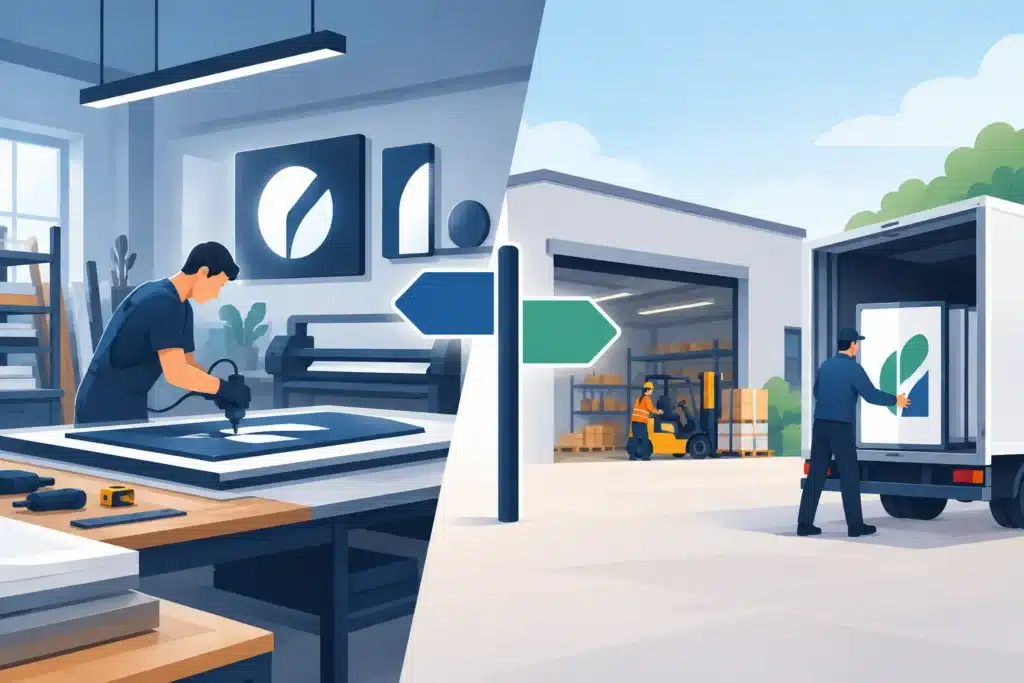
A sign project can look straightforward on a proposal and become complicated the moment production begins. A color needs to match an existing fleet wrap. A landlord requires a revised drawing. A routed panel has to fit a field condition that was not apparent from the plans. That is where in-house fabrication vs outsourcing becomes more than a purchasing detail. It affects schedule certainty, quality control, communication, and who is accountable when the sign is ready to install.
For business owners, facilities teams, contractors, and marketing managers, the real question is not whether every component must be made under one roof. It is whether the sign partner has the production control and project management needed to deliver the finished result without passing problems from one vendor to the next.
In-House Fabrication vs Outsourcing: What Changes
In-house fabrication means a sign company performs a meaningful share of production with its own people, equipment, and processes. Depending on the shop, that can include large-format printing, vinyl production, routing, painting, channel letter assembly, cabinet work, finishing, and quality checks. The same company may also handle site surveys, permitting support, installation, and future service.
Outsourcing means some or all production is sent to an outside manufacturer or trade supplier. This is common in the sign industry and is not automatically a problem. Many strong sign companies use specialty partners for capabilities that are impractical to maintain locally, such as highly specialized digital displays, custom architectural metalwork, or certain formed components.
The difference is in control. When fabrication is handled internally, the project team can inspect materials, verify dimensions, adjust artwork, and coordinate production with the installation crew in real time. When a project relies heavily on outside production, changes and corrections may require additional approvals, shipping time, and another place for details to get lost.
For a commercial sign program, that distinction matters most when the work involves custom dimensions, strict brand standards, a fixed opening date, or site conditions that require practical judgment.
The Advantages of In-House Sign Fabrication
The strongest case for in-house fabrication is accountability. The team that reviews your plans and approves your artwork is closer to the people making the sign. If there is a question about a paint finish, mounting method, vinyl color, or production sequence, it can be addressed directly rather than sent through several layers of communication.
Better control over quality and consistency
Brand consistency is not limited to putting the correct logo on a sign. It includes color accuracy, line weights, material finishes, illumination appearance, graphic alignment, and how the sign looks from the intended viewing distance. These details are easier to monitor when printing, routing, painting, and assembly are coordinated by one production team.
This is especially valuable for multi-part projects. A business may need an exterior wall sign, interior wayfinding, window graphics, vehicle lettering, and construction signage at the same time. Producing key elements in-house helps keep the visual system aligned across those applications.
In-house capability also makes it easier to catch issues before a crew arrives on site. A cabinet that needs a revised mounting point or a panel that needs a minor adjustment can be addressed in the shop instead of becoming an installation-day surprise.
More responsive schedules
Signage schedules rarely stay static. Construction timelines shift, permits take longer than expected, and a new tenant may need temporary signs before permanent signage is approved. Internal production capacity gives a sign partner more options when priorities change.
That does not mean every rush project can be completed immediately. Materials, approvals, permitting, and installation access still set real limits. It does mean the production team can evaluate the actual work, reprioritize where appropriate, and communicate a realistic path forward without waiting for an outside supplier to respond.
For Northern Colorado and Southern Wyoming businesses, local production can also reduce dependence on freight schedules for common sign components and printed graphics. That can be meaningful when weather, jobsite access, or a launch date leaves little room for delay.
Greater flexibility for custom work
Commercial signs are often built around a specific building, brand, and viewing environment. A standard product may not fit an uneven facade, a narrow monument sign base, a historic district requirement, or a complex interior circulation plan.
In-house routing, printing, painting, and assembly give fabricators more room to adapt. A dimensional letter return can be adjusted. A panel can be resized. A custom color can be tested. A wayfinding system can be refined as interior finishes are finalized. These adjustments are part of doing custom work well, not signs that the original plan was flawed.
Closer coordination with installation and service
A sign is not finished when it leaves the shop. It has to be installed safely, mounted correctly, connected where needed, and evaluated in its actual environment. The installer needs accurate information about weight, attachment points, electrical requirements, access equipment, and site conditions.
When fabrication and installation are coordinated internally, the field team can provide useful feedback before production is complete. That may prevent a mounting conflict, reduce time on site, or lead to a more durable solution. The same connection helps when a sign needs maintenance, a face replacement, updated tenant information, or repair after weather damage.
Where Outsourcing Can Make Sense
Outsourcing is not a sign of poor service. It can be the responsible choice when a project calls for equipment, materials, certifications, or production volume beyond what a local shop should try to handle internally.
For example, a specialized electronic message center, a large run of standardized retail fixtures, or a unique formed-metal component may be better produced by a dedicated manufacturer. The key is that the sign company should remain responsible for selecting the right supplier, reviewing the work, coordinating logistics, and integrating that component into the overall installation.
A hybrid approach is often the most practical. A local sign partner may fabricate the custom cabinets, printed graphics, routed panels, and installation hardware in-house while sourcing a specialized illumination component or display system. That arrangement can provide the advantages of local project control without forcing every part of the job into a one-size-fits-all production model.
The concern is not outsourcing itself. The concern is outsourced work without clear ownership. If a supplier misses a dimension, who resolves it? If a shipment arrives damaged, who manages the replacement? If the installed sign does not match the approved design, who has the authority and willingness to make it right? A dependable sign partner should have direct answers.
Questions to Ask Before Choosing a Sign Partner
You do not need to inspect every machine in a fabrication shop to make a sound decision. You do need to understand how your project will move from concept to installation. Ask which portions of the project are fabricated in-house, which are sourced from specialty suppliers, and who performs final quality checks.
It is also useful to ask how the company handles changes after approval. Construction and property management projects frequently evolve. A capable partner can explain what changes are simple, what may affect cost or timing, and how they will protect your deadline.
For exterior signs, ask about site verification, permitting responsibilities, installation planning, and service after the sign is installed. For interior graphics and wayfinding, ask how the team manages phased construction, room-number changes, and future additions. The answers reveal whether you are buying a product or working with a partner that understands the full scope of the project.
Price should be part of the conversation, but it should not be the only measure. A lower initial quote can become expensive if it excludes site coordination, requires multiple vendors, or creates delays that affect an opening date. The most useful proposal makes the scope clear: what is being fabricated, what is being installed, what approvals are needed, and what support remains available after completion.
Choose the Right Level of Control for the Project
A simple banner order does not require the same production strategy as a hospital wayfinding package, a multi-location rebrand, or an illuminated storefront sign. The right approach depends on complexity, timing, customization, material requirements, and long-term service expectations.
For projects where appearance, fit, and installation coordination carry real business consequences, in-house capabilities provide a practical advantage. They give the sign company more direct control over the details that determine whether the finished work supports your brand and performs in the field.
Action Signs approaches fabrication as part of the larger job: understanding the site, producing the right components, installing them correctly, and remaining available when your business changes. The best sign partner is not simply the one that can make a sign. It is the one prepared to stand behind how that sign is planned, built, and maintained.


