
A forklift turning out of a rack aisle, a wash station partially blocked by pallets, or an unmarked electrical room can create risk in seconds. The best manufacturing plant safety sign examples do more than meet a requirement. They put clear direction where employees, visitors, and contractors need it most, helping a busy facility run with fewer avoidable interruptions.
For plant managers and safety teams, signage works best as part of the facility itself. It should be easy to see, consistent from department to department, built for the environment, and installed where a decision has to be made. A small label hidden behind equipment rarely changes behavior. A durable, properly placed sign at eye level can.
Manufacturing Plant Safety Sign Examples by Function
A complete safety sign program is usually made up of several sign types. The right mix depends on your process, equipment, traffic patterns, and site-specific hazards. A food production floor, welding area, distribution operation, and machine shop may all use similar categories, but their materials, wording, and placement will differ.
Hazard warning signs
Hazard signs alert people to conditions that can cause injury or require special precautions. Common examples include signs for high voltage, hot surfaces, pinch points, moving machinery, overhead loads, compressed gas, corrosive chemicals, and laser or radiation areas.
These signs should be placed before a person enters the hazard zone, not only on the equipment itself. For example, a high-voltage warning on an electrical panel is necessary, but a clearly marked electrical room door gives advance notice before someone enters. On large equipment, combining a prominent header with smaller equipment-specific labels can make the warning easier to understand without cluttering the work area.
Required PPE signs
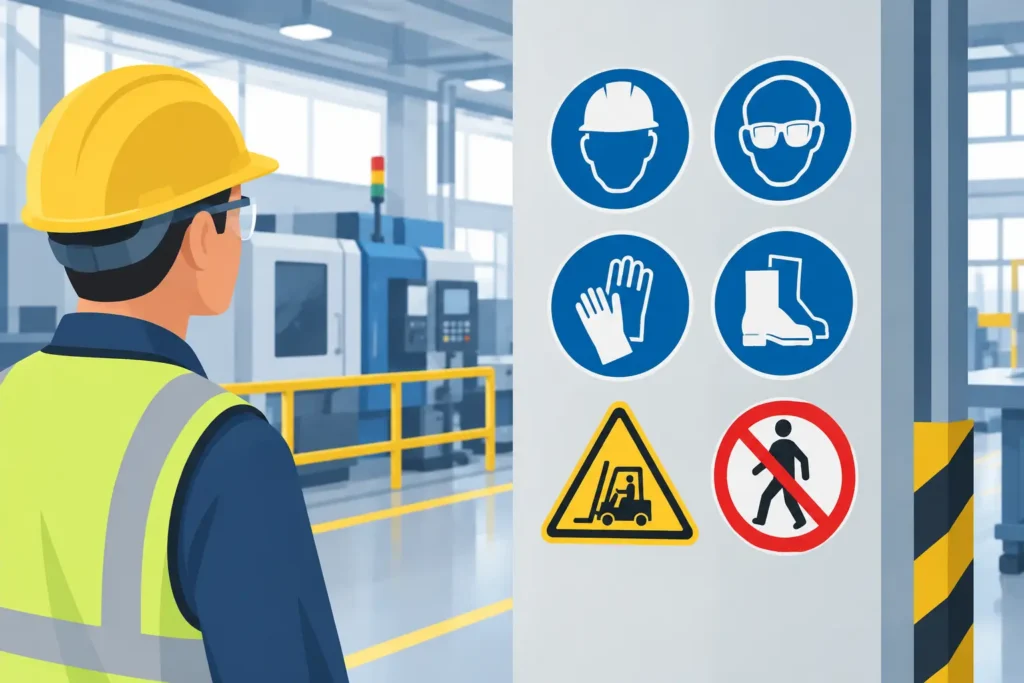
Personal protective equipment signs make expectations immediate at the point of exposure. Examples include “Safety Glasses Required,” “Hearing Protection Required,” “Face Shield Required,” “Steel-Toe Footwear Required,” and “Respirator Required Beyond This Point.”
The wording should match the actual task and area. A blanket PPE message across an entire building can lose meaning if requirements vary by department. Clearly defined zone signs are more useful: eye protection at the machining entrance, hearing protection near high-decibel equipment, or cut-resistant glove requirements at a material handling station.
Pictograms are especially valuable in facilities with multilingual teams, temporary staff, or regular visitors. They reinforce the message quickly, but the symbol and text need to work together. A sign should not leave employees guessing which type of protection is required.
Emergency and life-safety signs
During an emergency, people do not have time to search for instructions. Exit signs, evacuation route signs, assembly point markers, first-aid signs, AED signs, eyewash and emergency shower identification, fire extinguisher signs, fire alarm pull station markers, and emergency shutoff labels all support faster response.
Visibility is the deciding factor. Equipment, racking, open doors, and seasonal inventory changes can obscure signs that were visible when first installed. In larger plants, projecting signs, overhead markers, or wall-mounted directional signs may be needed to keep exits and emergency equipment visible from the main travel path.
Photoluminescent signs can be a smart addition in locations where a power outage could reduce visibility. They are not a substitute for code-required emergency lighting, but they can provide another visual reference along egress routes. The best option depends on the building layout, local requirements, and the conditions of the space.
Forklift and pedestrian traffic signs
Vehicle-pedestrian interaction is one of the clearest places where facility signage can prevent confusion. Floor markings alone can wear down or disappear under dust, traffic, and cleaning. Supporting them with fixed wall, post, or overhead signs makes the traffic plan easier to follow.
Useful examples include forklift crossing signs, pedestrian walkway signs, stop signs at aisle intersections, yield signs, blind-corner warnings, speed limit signs, loading dock traffic instructions, and “No Pedestrian Access” signs for active vehicle zones. In areas with limited sightlines, a sign may need to be paired with mirrors, guardrails, gates, or warning lights. Signage communicates the rule, but physical controls often provide the stronger layer of protection.
For traffic signs, consistency matters. Use the same colors, symbols, and message structure throughout the plant so workers do not have to interpret a new visual system at every intersection.
Machine and process identification signs
Machine labels and process signs support safety, maintenance, and efficient operations. They can identify equipment numbers, lockout points, disconnects, shutoff valves, pressure zones, authorized operators, and maintenance instructions. Clear identification also helps outside technicians and emergency responders understand the area faster.
Lockout/tagout-related signage deserves particular care. Permanent labels can identify energy isolation points and equipment boundaries, while procedures and tags provide task-specific direction. The exact approach should align with your documented safety program and the equipment involved. Avoid using a generic sign as a replacement for training, procedures, or required lockout devices.
Chemical and housekeeping signs
Chemical storage areas need clear identification for flammables, oxidizers, acids, compressed gases, and other controlled materials. Signs can also designate spill kit locations, waste streams, secondary containment areas, and restricted storage zones.
Housekeeping signs may seem less urgent, but they support safe movement and cleaner work areas. “Keep Aisle Clear,” “No Storage in Front of Electrical Panel,” “Return Tools After Use,” and “Maintain 36 Inches of Clearance” messages can address recurring issues before they become blocked access routes or trip hazards. For areas where a message needs to last, a rigid sign or applied graphic is usually a better choice than a paper notice taped to a wall.
Choosing Materials That Hold Up in a Plant
The most visible design is ineffective if the sign fades, peels, or becomes unreadable after a few months. Material selection should reflect the actual conditions in each area.
Indoor office-adjacent spaces may only need printed wall signs or interior panels. Production areas can require more durable substrates such as aluminum, rigid plastic, or laminated graphics that stand up to cleaning, moisture, abrasion, and temperature changes. Near welding, chemical processing, washdown operations, or exterior loading areas, durability requirements increase further.
Adhesive labels are useful on machinery and panels, but surface preparation matters. Oil, dust, textured paint, heat, and frequent cleaning can affect adhesion. For signs on walls, posts, cages, and rack ends, mechanically mounted panels may provide a longer service life. There is no single material that is right for every location. The practical choice balances exposure, viewing distance, replacement needs, and budget.
Design and Placement Make the Message Work
Safety signage has one job: communicate quickly. That calls for large, legible type, strong contrast, familiar colors, and a limited amount of information. A long paragraph of text may be technically accurate but still fail at the point of use.
Viewing distance should guide sign size. A message intended for someone standing at a machine can be smaller than an evacuation direction sign viewed across a warehouse aisle. Mounting height also matters. Signs placed too high can be missed, while signs mounted behind carts, doors, or stored materials are effectively absent.
Consider the route people take through the area. Place a required PPE sign at the entrance before the exposure begins. Put a forklift crossing warning where both drivers and pedestrians can see it before reaching the intersection. Mark emergency equipment with a sign that remains visible when the equipment is partially blocked by normal activity.
Color can help people recognize a message category quickly, but it should be used consistently and supported by clear words and symbols. Employees with color-vision differences, visitors unfamiliar with the facility, and people working under low light all benefit from direct communication rather than color alone.
Build a Sign Program That Stays Current
A plant changes over time. New equipment is installed, aisles move, inventory expands, processes shift, and safety requirements evolve. Safety signs should be reviewed as part of those changes rather than treated as a one-time installation.
Start with a walkthrough that follows the experience of a new employee or delivery driver: where they enter, what they see first, where traffic crosses, how they find emergency equipment, and which areas require authorization or PPE. Include operations, maintenance, safety, and facilities personnel. Each group sees different gaps.
Then standardize what can be standardized. Establish common sign formats for hazards, equipment IDs, traffic control, emergency markers, and department identification. This helps the facility look organized and makes future additions faster. Keep a record of sign locations and specifications so damaged or outdated pieces can be replaced without starting over.
Action Signs can help Northern Colorado and Southern Wyoming manufacturers turn a safety walkthrough into a coordinated sign package, from durable production-area signs and facility wayfinding to installation and replacement planning.
A well-marked plant does not rely on workers to remember every risk from orientation day. It gives them clear, durable cues at the moment they need to act, then keeps those cues current as the operation grows.


