
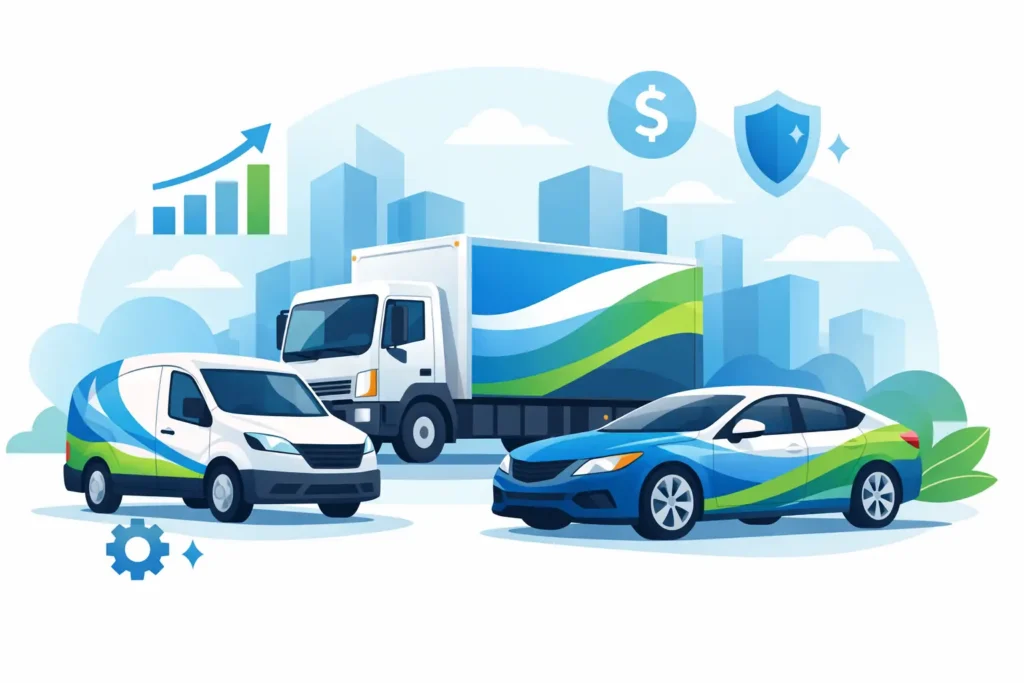
A service van parked at a jobsite, a delivery truck at a stoplight, and a sales vehicle outside a customer’s office all have one thing in common: they are visible before anyone says a word. The top benefits of fleet wraps come from putting that daily visibility to work for your business, not treating your vehicles as blank transportation.
For companies across Northern Colorado and Southern Wyoming, fleet graphics can turn routine travel into steady local exposure. They also support the operational side of a growing company by keeping branded vehicles consistent, protecting portions of the original paint, and making it easier for customers to recognize the team arriving at their location.
Why Fleet Visibility Matters in Local Markets
Most regional businesses do not need recognition from everyone in the country. They need to be known by the people who live, work, shop, and build within their service area. A well-designed fleet wrap puts your name, services, and visual identity in front of those people during normal business operations.
Unlike a campaign that runs for a fixed period, a vehicle wrap remains visible wherever the vehicle is working. A contractor’s truck may be seen at supply houses, residential neighborhoods, commercial sites, and along major corridors in the same week. A healthcare provider, restaurant group, property manager, or professional service firm can create similar impressions simply by using branded vehicles consistently.
That exposure is especially valuable when customers are already looking for a provider. Familiarity matters. When a homeowner needs HVAC service or a facilities manager needs a reliable contractor, a company they have noticed around town may feel more established than one they have never seen.
Top Benefits of Fleet Wraps for Business Growth
Build recognition on every route
The most immediate benefit is visibility. A fleet wrap makes a vehicle easier to identify from a distance and gives passersby a clear connection between the vehicle and your business. Strong color contrast, readable lettering, and an uncluttered layout matter more than trying to fit every service, phone number, and credential onto one panel.
A wrap should answer the basic question quickly: who is this company, and what do they do? For many businesses, a logo, a short service description, a phone number, and a memorable visual element are enough. The goal is not to create a brochure on a truck. It is to create a recognizable moving brand asset.
Keep your brand consistent across the fleet
Customers notice inconsistencies, even when they cannot explain why. A mixed fleet of plain white vans, faded decals, old logos, and mismatched colors can make a growing operation look disorganized. Consistent wraps or fleet graphics give vehicles a unified appearance, whether you operate three service vans or dozens of trucks across multiple locations.
Consistency also helps internally. Employees know they are representing the company when they drive a clearly branded vehicle. For businesses with field teams, that can reinforce professional standards at job sites, customer homes, and community events.
The best approach is usually to develop a repeatable vehicle graphics system rather than redesigning each vehicle from scratch. Core brand elements stay consistent, while layouts are adjusted for the body style, doors, windows, box panels, and safety requirements of each vehicle.
Create marketing value from an existing expense
Your fleet already has costs: payments or depreciation, fuel, insurance, maintenance, and labor. Wrapping a vehicle does not eliminate those expenses, but it can make a necessary business asset contribute more directly to marketing.
The value depends on how often vehicles are driven, where they travel, how readable the design is, and whether your business serves a defined territory. A heavily used plumbing truck or delivery van may generate more impressions than a vehicle that stays parked most days. For that reason, fleet wraps are often most effective when applied first to high-mileage or customer-facing vehicles.
There is also a practical budgeting advantage. Once the artwork and specifications are established, adding graphics to new vehicles is more predictable than starting a new advertising campaign each time the fleet expands. This makes fleet branding easier to plan for as part of growth.
Help customers feel confident at the point of service
For service businesses, the customer experience begins before a technician rings the doorbell. A marked vehicle tells the customer that the person arriving is connected to the company they called. That can be particularly helpful for home services, healthcare, property management, utilities, and businesses whose teams work on active commercial sites.
Clear fleet identification also helps building managers, school administrators, security personnel, and jobsite supervisors quickly verify who is on site. In many cases, the wrap is not only a marketing tool. It is a practical part of professional appearance and site coordination.
Protect factory paint and support vehicle appearance
Quality vinyl wraps and graphics can provide a protective layer over covered painted surfaces. They can reduce exposure to minor scuffs, road debris, and sun-related wear, though they are not a substitute for proper vehicle care or protection from significant impact damage.
This benefit is most relevant when materials are selected and installed correctly. A poorly installed graphic can lift at edges, collect dirt, or fail before it delivers the expected return. Material choice, surface preparation, curing conditions, and installation technique all affect performance.
When it is time to retire or sell a vehicle, professionally applied wrap material can typically be removed without harming sound factory paint. Results vary based on paint condition, vehicle age, prior bodywork, and how long the graphics have been in place. It is wise to assess those factors before committing to a full wrap.
Make rebrands and fleet changes more manageable
A full repaint is a significant commitment. Fleet wraps offer more flexibility when a company updates its logo, adds a new service line, changes a phone number, or acquires another business. Graphics can be revised or replaced without permanently changing the vehicle’s original finish.
That does not mean every update requires a full wrap replacement. In some cases, a well-planned partial wrap or panel graphic system allows individual elements to be updated efficiently. The right solution depends on the vehicle, the extent of the rebrand, and the condition of the existing graphics.
What Determines Fleet Wrap Return on Investment
A fleet wrap works best when it is treated as a business communication tool, not an afterthought. The design must be legible at driving distance, and the message must match how customers actually find and evaluate your company.
Start with the service area and vehicle use. A company that spends most of its time on I-25 needs bold, simple graphics that read quickly. A vehicle frequently parked at neighborhood job sites may have more opportunity for secondary details, such as a web address or a concise service list. If most new customers come through referrals, the wrap should reinforce credibility and recognition rather than attempt to carry an aggressive promotional offer.
The vehicle itself also matters. Cargo vans, box trucks, pickups, trailers, and passenger vehicles offer very different design surfaces. Door handles, body seams, windows, rivets, fuel doors, and safety markings all need to be considered before production. An experienced graphics partner plans around those details so the finished installation looks intentional rather than forced onto the vehicle.
Durability is another ROI factor. Lower-cost materials may be suitable for short-term promotions or temporary use, but they may not be the right choice for a vehicle exposed to intense sun, winter road conditions, frequent washing, and high annual mileage. Discuss expected service life, cleaning practices, and replacement planning before selecting materials.
Full Wraps, Partial Wraps, and Fleet Graphics
A full wrap delivers the strongest visual impact because it can transform the entire vehicle into a branded surface. It is often a good fit for companies with high-visibility routes, established brand standards, or a need to make a strong impression in competitive markets.
Partial wraps can be equally effective when they use the vehicle’s base color strategically. They can cover large sections of the body while leaving other painted areas visible, providing a substantial branded look at a lower material and installation cost. For many small and mid-sized businesses, this is the practical middle ground.
Cut vinyl lettering and spot graphics are a sensible choice when clear identification is the priority. They work well for smaller fleets, temporary vehicles, equipment, or businesses that need basic branding without the coverage of a wrap. The right choice should follow your visibility goals, vehicle lifecycle, and budget, not a one-size-fits-all package.
Plan Fleet Graphics for the Long Term
Fleet branding is easier to manage when design, production, installation, and future replacements are coordinated from the beginning. Keep approved logo files, color specifications, vehicle templates, and installation records organized. That reduces delays when a new truck arrives, a lease vehicle changes, or a damaged panel needs to be replaced.
It also helps to establish standards for vehicle cleaning and inspection. Regular washing keeps graphics readable and professional. During routine maintenance, check for lifted edges, abrasion around handles, or damage from jobsite conditions. Addressing a small issue early can prevent a larger replacement later.
Action Signs can help businesses plan vehicle wraps and fleet graphics around real operating conditions, from initial design through in-house production and installation. A properly planned fleet program gives each vehicle a clear job: show customers who is arriving, reinforce the brand they recognize, and keep working for the company between every stop.


